• Skip to main content
  • Skip to secondary menu
  • Skip to footer

Israel News

#Israel: Israel in social media

  • About
  • Sponsored Post
  • Contact

Year Zero, Tel Aviv Museum of Art

February 5, 2026 By admin Leave a Comment

Year Zero unfolds like a quiet reckoning with the moment just before everything broke, when culture still believed in continuity and institutions still assumed tomorrow would resemble today. At the Tel Aviv Museum of Art, the exhibition looks back to the eve of World War II and reconstructs the fragile chain of decisions, memories, and acts of persistence that allowed modern art to survive displacement and annihilation. At its emotional core stands Dr. Karl Schwarz, the museum’s first director, who in the late 1930s embarked on what can only be described as a desperate final journey through Europe. Schwarz was not collecting opportunistically; he was searching for something he had seen in his youth in Berlin, a work that had stayed with him as the political and moral climate darkened. He traced it to Amsterdam and persuaded its owner to send it to Tel Aviv, an act that now reads as both practical and symbolic. That single rescue echoes through the exhibition, because between 1933 and 1945 Schwarz saved thousands of works under similar conditions. These paintings and sculptures, removed just in time from a continent turning hostile to their creators, became the nucleus of the museum’s Modern Art Collection. Year Zero is not interested in triumphal narratives; it is about the thin margin between preservation and erasure.

One painting crystallizes this tension with almost unsettling clarity: Leonid Pasternak’s Max Liebermann Opening an Exhibition at the Academy in Berlin, 1930. The canvas is dense, crowded, and inward-looking, its figures pressed together in a compressed social space that already feels unstable. Max Liebermann sits at the center, bald, bespectacled, bent over a sheet of paper, his attention fixed, his posture heavy with thought. Around him, faces emerge and dissolve into thick, restless brushstrokes—earthy browns, muted blues, sudden reds that flare and then retreat. A woman in a red hat stands just behind him, her features softened and unfinished, while other figures stack into the background, their individuality partially erased by proximity. The brushwork is rough, almost impatient, as if solidity itself were no longer trustworthy. Painted in 1930, the scene captures a cultural ceremony at the very edge of collapse, an academy still functioning, an exhibition still opening, even as the conditions that made such gatherings possible were already unraveling.
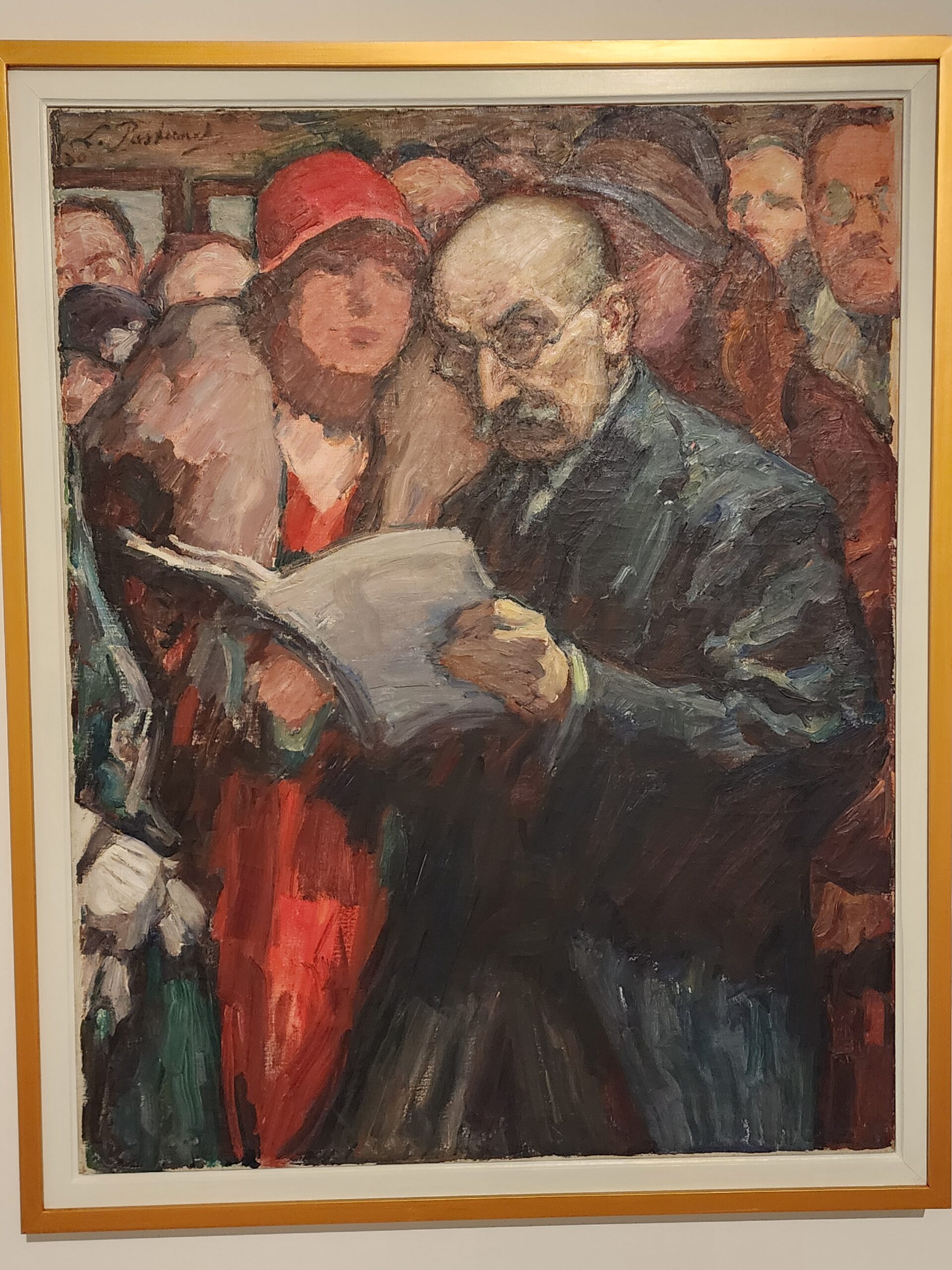
Leonid Pasternak’s Max Liebermann Opening an Exhibition at the Academy in Berlin, 1930

The painting gains another layer of meaning once you step slightly outside the frame. Leonid Pasternak was the father of Boris Pasternak, the author of Doctor Zhivago. That biographical fact creates a quiet but powerful bridge between visual art and literature, between this crowded Berlin interior and the sweeping moral landscapes of a novel that would later grapple with revolution, exile, and the endurance of private conscience under historical violence. Doctor Zhivago is haunted by the same tension visible in the painting: cultivated people absorbed in art, love, and thought while vast forces reorganize the world around them with little regard for individual lives. Seen this way, Pasternak’s painting reads almost like a visual preface to his son’s literary universe, a frozen moment of cultural concentration before history intrudes with full force. Father and son, each in a different medium, end up documenting the same rupture from opposite sides of time.

Year Zero extends this logic across the galleries, bringing together works by Alexander Archipenko, Marc Chagall, Käthe Kollwitz, and others not as isolated masterpieces but as survivors. The exhibition marks the 80th anniversary of the end of World War II, yet it deliberately lingers in the years just before the war, when outcomes were not yet sealed and individual actions still mattered. Many of the figures in these works are reading, thinking, grieving, or simply enduring, their gazes turned inward rather than outward. The cumulative effect is not nostalgia but unease. These are not heroic images; they are records of concentration, doubt, and fragile normalcy. What emerges is a portrait of modern art shaped not only by innovation and rebellion, but by rescue—by people who understood that culture does not survive on its own. Walking through Year Zero, you begin to sense that modernism, as preserved here, is less a story of progress than of narrow escapes, and that the survival of these works is inseparable from the moral clarity of those who refused to let them disappear into the noise of history.

Filed Under: Featured Posts

Reader Interactions

Leave a Reply Cancel reply

Your email address will not be published. Required fields are marked *

Footer

Recent Posts

  • Year Zero, Tel Aviv Museum of Art
  • IMTM 2026: Recovery Is Still Missing, and the Gaps Are Getting Harder to Ignore
  • Milk Reform Standoff in Israel: Why Farmers Are Blocking Supply and Supermarkets Are Rationing
  • Moody’s Shifts Israel’s Outlook to Stable: A Signal of Resilience, Not Yet a Rebound
  • Cybertech 2026: Resilience at the Core as Tel Aviv Conference Unfolds Amid National Closure and Endurance
  • Karma, Haifa — A Strange Experience Before You Even Sit Down
  • BBC, Gaza, and the Selective Morality Israelis Know Too Well
  • The Strong Shekel Paradox: Why Israel’s Currency Rises While the Country Is Under Strain
  • Third Place, Hard Earned: Israel’s Economy Seen From Above
  • Prolonged Power Outage and Huge Column of Smoke Reported in Haifa

Media Partners

  • Cybersecurity Market
  • Media Partners
Fortinet Stock Rises as Wall Street Drops the AI Fear Narrative
AUTOCRYPT Expands Cyber Vision Into MENA: 2026 Marks a Turning Point
CrowdStrike, AWS, and NVIDIA Expand Global Cybersecurity Accelerator to Empower AI-Driven Innovation
Check Point Earns Leader Position in 2025 Gartner Magic Quadrant for Email Security
When Fraud Learns Faster Than Humans: The 2026 Wake-Up Call for Enterprise Finance
Lumu’s 2026 Compromise Report: Why Cybersecurity Has Entered the Age of Silent Breaches
SentinelOne Expands AI Security Capabilities with New AWS Integrations
XM Cyber Positioned as Challenger in Gartner’s 2025 Magic Quadrant for Exposure Assessment Platforms
How Sweed’s Bug Bounty Elevates Cannabis Cybersecurity
Afero and Texas Instruments Redefine Cybersecurity at the IoT Edge
Press Club
Domain Aftermarkets
Photo Studio
Transportational
Market Research Media
Nameable
Syndicator
Opinion
Agile Soft Dev
Publishing House

Media Partners

  • Defense Market
  • Media Partners
NATO’s July 2024 Washington, DC Summit: A Comprehensive Overview
The David Sling air defense system sold to Finland
AeroVironment Secures $288 Million Delivery Order for Switchblade® Loitering Munition Systems Under U.S. Army Contract
Vatn Systems Secures $13M Oversubscribed Seed Round to Revolutionize Naval Warfare
System High Awarded $49.9 Million Classified IT Destruction Contract
Iron Beam: Israel’s Cutting-Edge Defense Against Aerial Threats
L3Harris Secures $999 Million U.S. Navy Contract for Resilient Communications Technology
Leonardo DRS and BlueHalo Successfully Demonstrate New Counter-UAS Directed Energy Stryker, Shooting Down Drones in Live-Fire Engagement
AeroDef Manufacturing 2023: Leading Aerospace and Defense Manufacturing Event, November 7 – 9, 2023, Long Beach Convention Center, California
Reliable Robotics Performs Automated Cargo Deliveries for U.S. Air Force
Side Hustle Art
Policymaker
S3H
ESN
Posters
App Coding
3v
Domain Market Research
Domain Aftermarkets
Transportational

Copyright © 2015 IsraelNews.org

Technologies, Market Analysis & Market Research Reports, Photography

We use cookies on our website to give you the most relevant experience by remembering your preferences and repeat visits. By clicking “Accept”, you consent to the use of ALL the cookies.
Do not sell my personal information.
Cookie SettingsAccept
Manage consent

Privacy Overview

This website uses cookies to improve your experience while you navigate through the website. Out of these, the cookies that are categorized as necessary are stored on your browser as they are essential for the working of basic functionalities of the website. We also use third-party cookies that help us analyze and understand how you use this website. These cookies will be stored in your browser only with your consent. You also have the option to opt-out of these cookies. But opting out of some of these cookies may affect your browsing experience.
Necessary
Always Enabled
Necessary cookies are absolutely essential for the website to function properly. These cookies ensure basic functionalities and security features of the website, anonymously.
CookieDurationDescription
cookielawinfo-checkbox-analytics11 monthsThis cookie is set by GDPR Cookie Consent plugin. The cookie is used to store the user consent for the cookies in the category "Analytics".
cookielawinfo-checkbox-functional11 monthsThe cookie is set by GDPR cookie consent to record the user consent for the cookies in the category "Functional".
cookielawinfo-checkbox-necessary11 monthsThis cookie is set by GDPR Cookie Consent plugin. The cookies is used to store the user consent for the cookies in the category "Necessary".
cookielawinfo-checkbox-others11 monthsThis cookie is set by GDPR Cookie Consent plugin. The cookie is used to store the user consent for the cookies in the category "Other.
cookielawinfo-checkbox-performance11 monthsThis cookie is set by GDPR Cookie Consent plugin. The cookie is used to store the user consent for the cookies in the category "Performance".
viewed_cookie_policy11 monthsThe cookie is set by the GDPR Cookie Consent plugin and is used to store whether or not user has consented to the use of cookies. It does not store any personal data.
Functional
Functional cookies help to perform certain functionalities like sharing the content of the website on social media platforms, collect feedbacks, and other third-party features.
Performance
Performance cookies are used to understand and analyze the key performance indexes of the website which helps in delivering a better user experience for the visitors.
Analytics
Analytical cookies are used to understand how visitors interact with the website. These cookies help provide information on metrics the number of visitors, bounce rate, traffic source, etc.
Advertisement
Advertisement cookies are used to provide visitors with relevant ads and marketing campaigns. These cookies track visitors across websites and collect information to provide customized ads.
Others
Other uncategorized cookies are those that are being analyzed and have not been classified into a category as yet.
SAVE & ACCEPT