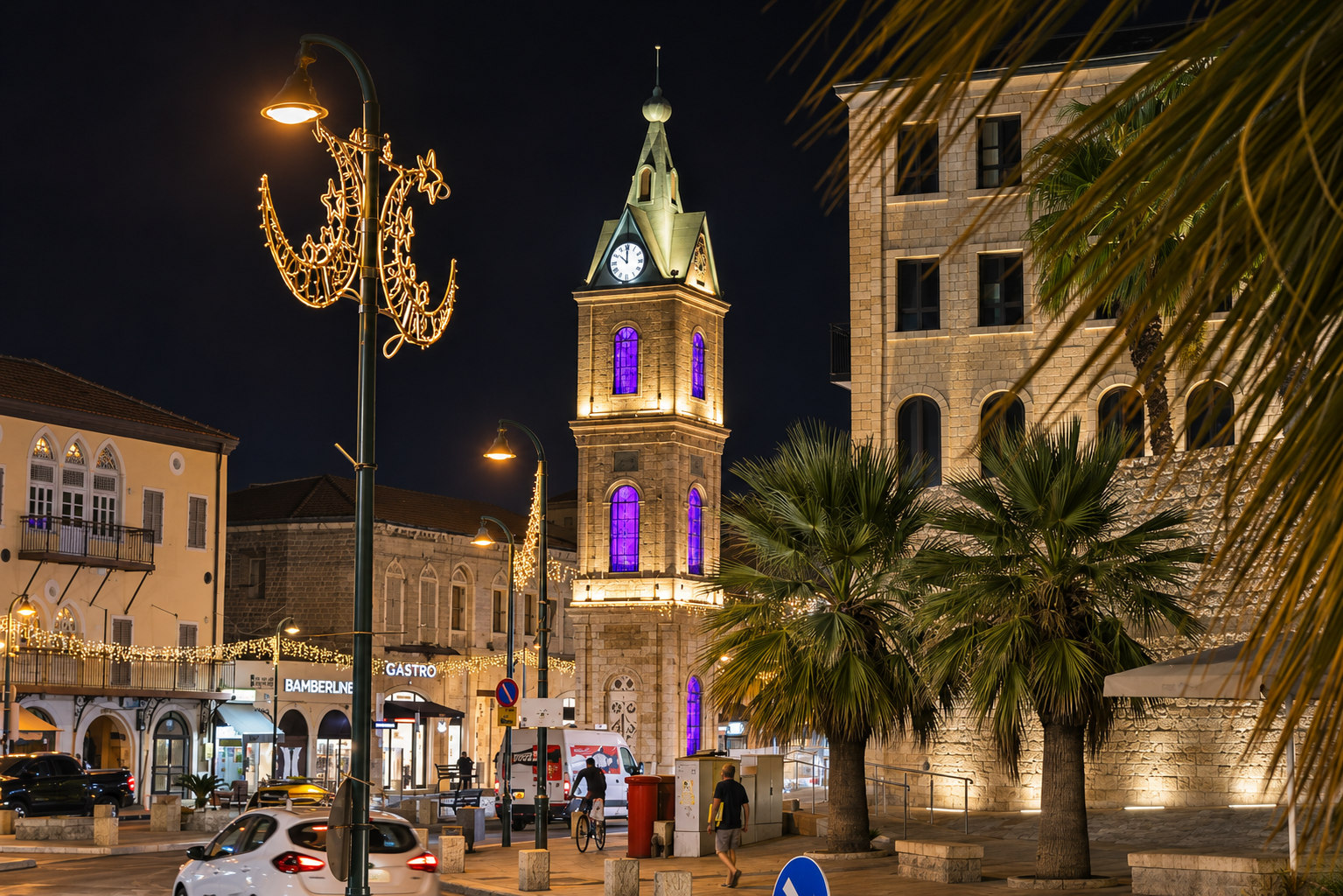
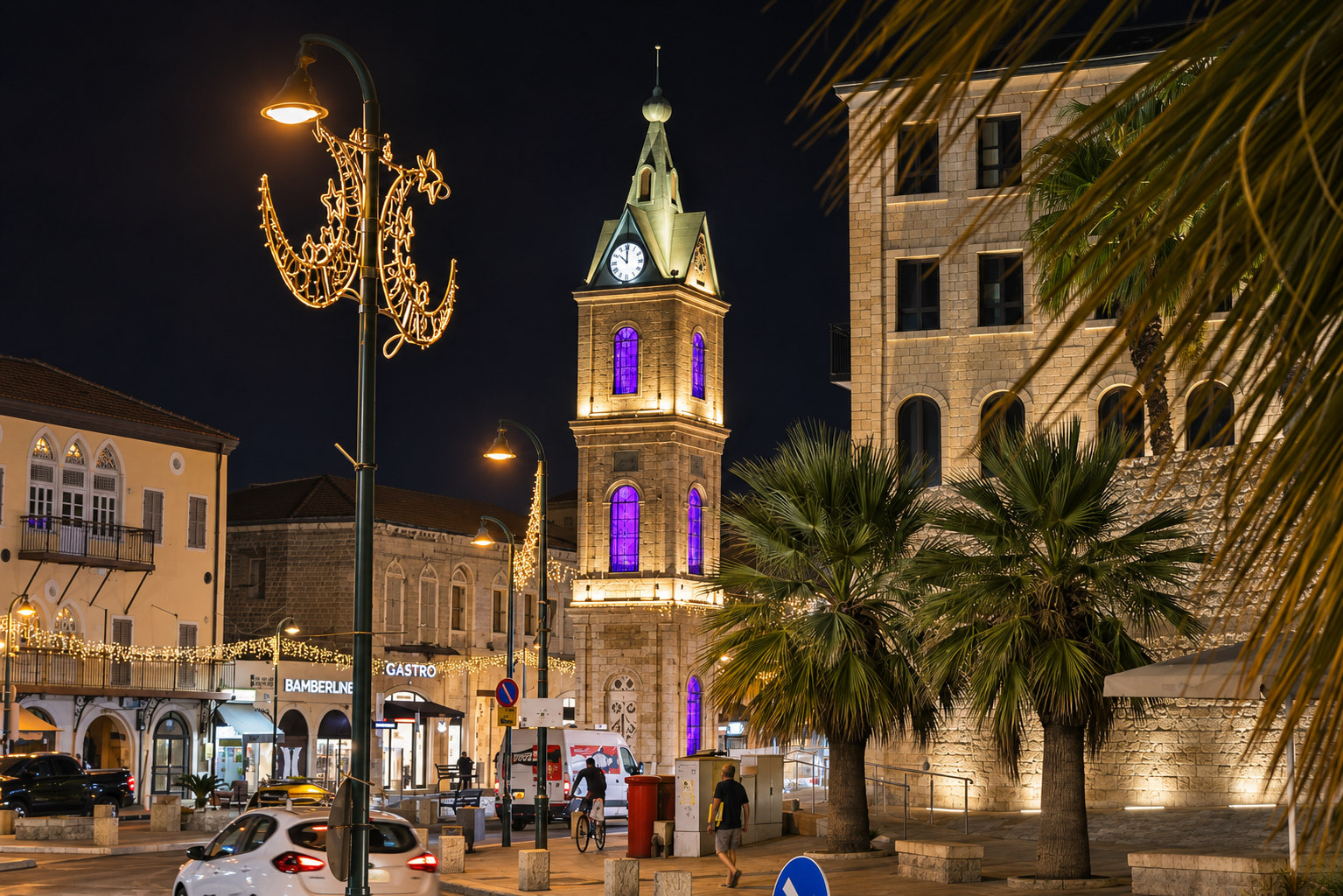
At night, Jaffa can look almost impossibly beautiful. Its Ottoman clock tower rises above the old streets, purple light fills the narrow tower windows, festive decorations glow above the traffic, and palm trees frame limestone facades. It is exactly the sort of picture that makes visitors stop and reach for a camera. Yet the scene also raises an uncomfortable question: how can one of Israel’s most distinctive historic urban districts be experiencing so many violent criminal incidents?
The recent record is disturbing. On June 28, 2026, a car exploded in Jaffa in what police investigated as a suspected gangland killing. On August 28, Ahmad Shukra was shot dead on Jerusalem Boulevard, while a grenade was reportedly thrown at a vehicle elsewhere in the city that night. Two days later, on August 30, separate shootings minutes apart left one man dead and another seriously injured. On September 15, 28-year-old Yassin Daka was shot dead on Rabbi Rubinstein Street, according to Israeli news reports. These are not ordinary neighborhood disturbances; they are fatal attacks and serious acts of violence taking place within a densely populated city.
The incidents did not end with the summer. A 34-year-old man was seriously wounded in an October 3 shooting on Yefet Street. On October 21, police investigated a suspected fragmentation-grenade explosion on HaHaruv Street; damage was reported but no injuries. On November 11, another young man was seriously wounded in a shooting on Tzih’teli Street. Police have also reported arrests in investigations into earlier Jaffa shootings, including the August 28 killing. An arrest is not a conviction, but it illustrates the continuing law-enforcement response to a succession of cases.
These incidents are evidence of a serious violent-crime problem, but they do not by themselves establish a precise year-on-year percentage increase in all criminal incidents in Jaffa. That would require a consistent, neighborhood-level police dataset covering the same categories and periods. What they do establish is that shootings, killings and explosives have repeatedly disrupted daily life in Jaffa in 2026. Even when an attack is directed at an individual, its effects extend to people living nearby, pedestrians, shopkeepers, drivers and children who may find themselves in the wrong place at the wrong time.
Jaffa’s complexity is also part of its character. The city contains Arab and Jewish communities, historic religious buildings, markets, restaurants, residential streets and a fast-changing real-estate landscape. Violent criminal networks should not be confused with the broader communities in which they operate. Residents are among the people who suffer most from extortion, fear, gunfire and the erosion of confidence that the police can keep their streets safe. Reducing this to a tourism problem would miss the most important point: it is first a public-safety problem for the people who call Jaffa home.
There are signs of a larger national crisis. The Abraham Initiatives, which monitors killings in Israel’s Arab community, recorded 201 victims of criminal violence across Israel by mid-November 2026. That is a nationwide measure, not a Jaffa-specific count. Researchers and community advocates have repeatedly pointed to organized crime, access to illegal firearms, disputes and inadequate enforcement as overlapping drivers of the violence. Whatever the causes in individual cases, the visible consequences are increasingly difficult to separate from the everyday image of the city.
For municipal and national authorities, the test is not whether Clock Square remains attractive to photographers. It is whether investigations lead to prosecutions, whether illegal weapons are removed, whether witnesses can speak without fear, and whether ordinary residents see a credible reduction in shootings and intimidation. Better public reporting of Jaffa-specific crime data would help determine whether enforcement is producing measurable results rather than simply generating announcements after each new incident.
The illuminated Jaffa Clock Tower remains a symbol of a beautiful and historically important city. The photograph is real, and so is the beauty. But the facade should not become an excuse to look away from what is happening on the streets beyond the frame. Jaffa deserves to be admired, and its residents deserve to feel safe.
Reporting: Times of Israel, July 2026; Times of Israel, August 30; Times of Israel, September 15; Walla, October 21; Posta, November 12; Times of Israel, November 8.